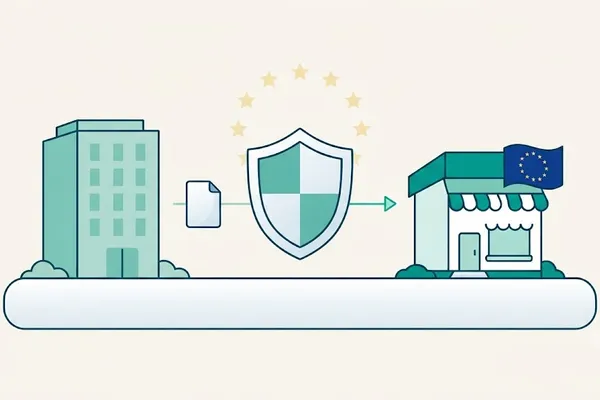
The value chain cap: what can a large client still ask of you?
In the previous part of this series we explained that the CSRD has been scaled back, but that as an SME you still get sustainability questions: from large clients and from your bank. A fair worry there is: where does it stop? Before you know it the questionnaires pile up, each one slightly different.
Good news: there is now a limit to that. It is called the value chain cap, the ceiling for the value chain. In this blog we explain what it is, who it applies to and what it means for you.
Why the limit exists
Large companies under the CSRD have to report on their entire value chain. To do that, they request data from their suppliers. Without any agreement, every large company could send its own list, each with different questions. For an SME with a few large clients that quickly becomes unworkable.
To prevent that, Europe has set a maximum. That maximum is the new voluntary standard, based on the VSME.
What the value chain cap actually means
The idea is simple: a large company may not ask a smaller party in its value chain for more information than the voluntary standard allows. So the VSME is not only your starting point, but also your ceiling.
One important detail: that limit is not the whole standard. The legal text contains a separate list (Annex II) setting out exactly which data a large client may request. Those are the so-called essential datapoints, and that list is considerably shorter than the standard as a whole.
A few things worth knowing:
- The limit protects companies that did not exceed an average of 1,000 employees in the preceding financial year. Virtually all SMEs fall under it.
- Do you have 10 employees or fewer? Then the list is shorter still. Questions about energy, CO2, water and waste fall outside the limit entirely for you; a client cannot demand them.
- Parts the standard marks as voluntary, or that only apply “if applicable”, fall outside the limit.
- The limit reaches into the Comprehensive module. So a large client may request a number of items from it, such as your main products and markets, your employee turnover and your code of conduct.
- Does a client still ask for more? Then they have to state which extra data they are asking for and that you may decline. That right to refuse is written into the law.
In short: the limit is the same for everyone, and you know in advance where you stand.
Where the limit does not apply
To be fair: the value chain cap is not a general ban on sustainability questions. It applies specifically to data a large company needs for its own mandatory sustainability reporting. Beyond that, there is still room:
- Your bank. If your bank asks for data for a loan or a credit assessment, that falls outside the limit. Banks, insurers and investors are encouraged in the legal text to keep their requests within this standard as far as possible. So a VSME report is still the logical answer for your bank too, you just cannot enforce the limit there.
- What’s in your contract. Whatever you have agreed contractually still stands.
- Other legislation. Data you have to supply under other European or national rules also falls outside it.
- What’s customary in your sector. Information companies normally share with each other, you can simply keep sharing.
Why this is good news for SMEs
This limit removes one of the biggest worries: the feeling that the questions are endless and differ per client. You only have to prepare for one standard. Once you have that in order, you have one report with which you answer your clients, and in practice your bank as well.
It also makes it easier to know in advance what is expected of you, instead of reacting to yet another request each time.
How Groene Otter helps
That essential set of data is exactly what our software walks you through. You enter your data once, clearly, and we turn it into a VSME report that you can share with clients and your bank. So you don’t have to figure out yourself which questions fall within the limit; that is already built into the tool.
See how it works on the features page, or take a look at the pricing.
What now?
The standard was adopted on 3 July 2026 and published in the Official Journal of the EU on 21 September 2026 as Delegated Regulation (EU) 2026/1560. It has been in force since 24 September, and you may use it to report voluntarily. The value chain cap itself applies to financial years beginning on or after 1 January 2027.
So you can get going now, at your own pace, and be ready when the first request comes in.
In the next part of this series we make it concrete: exactly which data you collect for a VSME report, and how to approach it step by step.
Don’t want to wait? Start for free and try it yourself, or book a demo and we’ll walk through it together.
Sources
This English version was translated from the Dutch original with the help of AI.